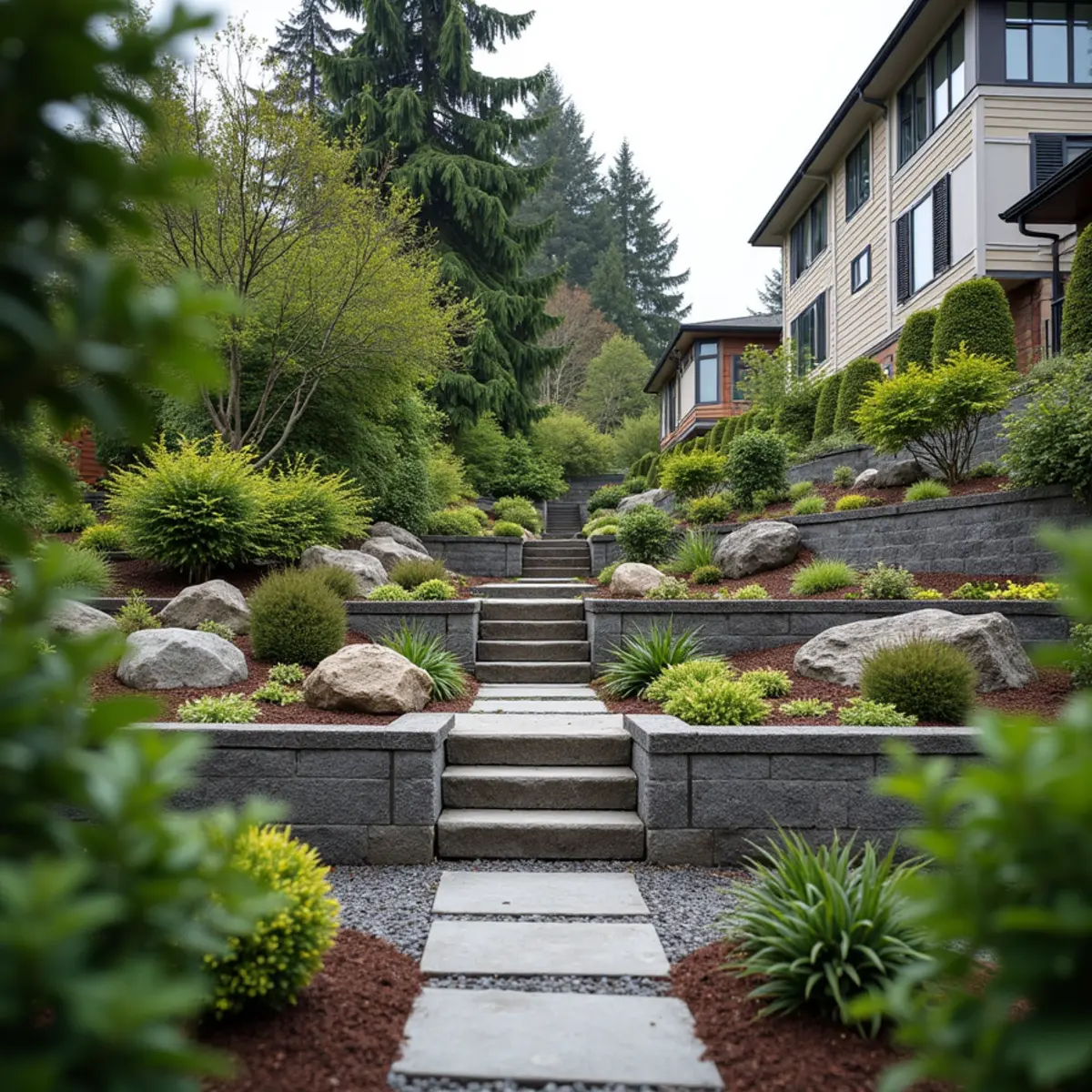
Engineered walls and traditional rockeries both tame a slope, but they suit different yards. Here is how to choose the right one for your Seattle lot.
Seattle is a city of hills, and a huge share of its yards slope. If you have a hillside that is eroding, wasting usable space, or threatening to slump, you have likely run into two options: an engineered retaining wall or a traditional rockery. They can look similar from the street, but they work in fundamentally different ways, and choosing the wrong one for your slope is an expensive mistake.
This comparison walks through how each works, what each costs, and which situations favor one over the other, so you can have an informed conversation with your contractor.
How Each One Actually Works
An engineered retaining wall is a structural system. Segmental blocks or poured concrete, often reinforced with geogrid extending back into the slope, are designed to hold a specific load. A traditional rockery, by contrast, is a facing of large stones placed against a cut slope. It armors and protects the face and resists erosion, but it is not an engineered structural wall in the same sense.
A retaining wall holds the hill back. A rockery dresses and protects a slope that can mostly hold itself.
When an Engineered Wall Is the Right Call
Engineered walls shine where the loading is serious and the space is tight. If you need a vertical face, want to create a level terrace on a steep grade, or the slope is carrying significant load, the structural approach is usually the answer.
- Steep or tall slopes that need to be held back at a near-vertical face.
- Creating flat, usable terraces out of an otherwise unusable grade.
- Situations where a structure sits above or below the wall.
- Anywhere an engineer's design and permitting are required.
When a Rockery Makes More Sense
Rockeries are a natural fit for gentler slopes and for homeowners who want an organic, Pacific Northwest look. They handle water beautifully because the gaps between stones let it pass, and they blend into naturalistic plantings far better than a block wall.
- Moderate slopes that need erosion protection more than structural restraint.
- A natural aesthetic that fits wooded or native-planted yards.
- Situations where free drainage through the face is an advantage.
- Terracing a hillside into planting pockets and garden beds.
Not Sure Which Your Slope Needs?
The right answer depends on the grade, the soil, and what sits above and below. A site visit settles it quickly. Call Florentino Landscaping at (323) 606-0255 and we will assess your slope and recommend the safer, more cost-effective option.
Call (323) 606-0255The Factor Both Share: Drainage
Whichever you choose, drainage is what determines whether it lasts. In Seattle's saturated soils, water building up behind a wall or slope creates hydrostatic pressure that can push out even a well-built structure. Engineered walls need gravel backfill and drain lines behind them, and rockeries rely on their natural gaps plus proper base drainage. Skip this, and the wall you paid for becomes the wall you rebuild.
Cost and Permitting Considerations
Retaining walls generally run between $3,620 and $10,000 depending on height, material, and drainage, and engineered walls sit toward the higher end because of the structural work involved. Remember that in Seattle, walls four feet or under are generally exempt from permitting when they are outside critical areas and do not threaten adjoining property, while taller walls typically require permits and engineering. Always confirm the specifics with SDCI.
Maintaining a Wall or Rockery
Whichever solution you choose, a little upkeep protects it for decades. The single most important habit is keeping the drainage behind and around the structure working, since clogged drains and trapped water are the leading cause of wall failure in our climate. Watch for bulging, leaning, or separating sections, which signal pressure building behind the face, and address them early before a small movement becomes a collapse. On a rockery, keep the plantings healthy so their roots continue binding the slope, and clear debris from the gaps that let water pass through. A wall or rockery that is checked each year and kept draining will comfortably outlast the homeowners who built it.
- Keep drain lines and weep points clear so water never builds up behind the face.
- Inspect yearly for bulging, leaning, or separating sections.
- Maintain healthy plantings on a rockery to keep roots binding the soil.
- Address small movements early rather than waiting for a failure.
Tame Your Slope the Right Way
Both engineered walls and rockeries can transform a difficult slope, but the best choice depends on your grade, your soil, and what you want the space to do. Get an honest assessment before you commit. Florentino Landscaping LLC builds both retaining walls and rockeries across Seattle and Issaquah, and we will recommend the option that is safest and most cost-effective for your yard. Call us at (323) 606-0255.
Frequently asked questions
Often, yes, especially on gentler slopes, because it involves less structural work. But the right choice depends on how much load the slope carries, not just budget.
Absolutely. Drainage is what makes either one last in Seattle's saturated soils. Water building up behind a wall or slope is the number one cause of failure.
Both last decades when built correctly with proper drainage. The determining factor is quality of construction, not the type. A poorly built version of either will fail.
It depends on grade, soil, and loading, which is best judged on site. Call (323) 606-0255 and we will assess your slope and recommend the right approach.